
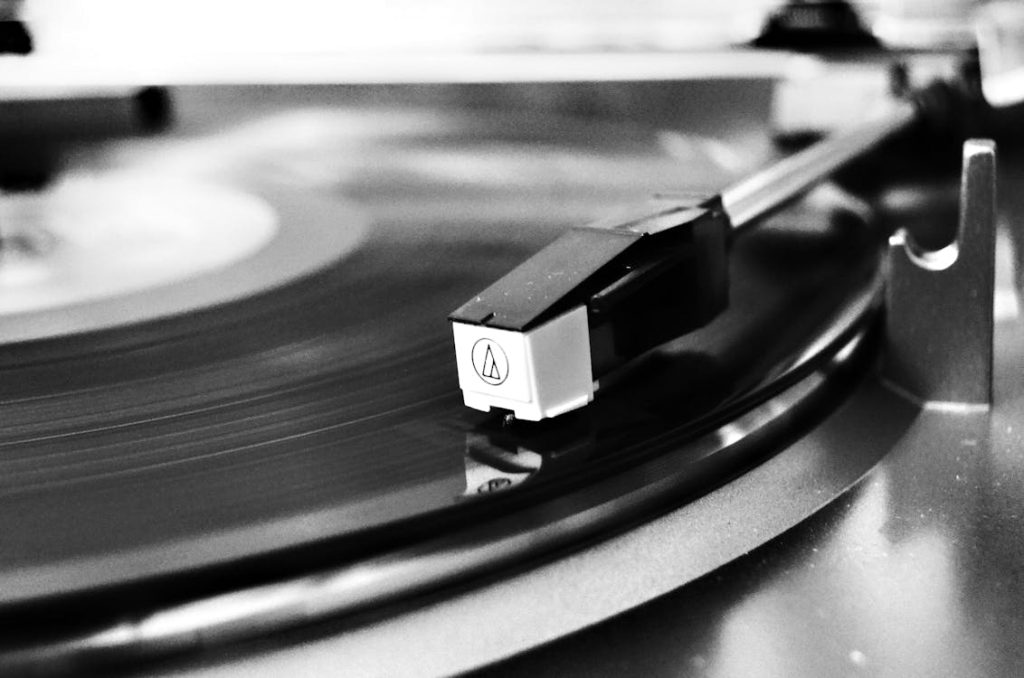
There is a moment, known to every vinyl listener, that streaming has never been able to replicate. It happens somewhere between lifting the record from its sleeve and lowering the stylus to the groove — a pause, barely a second long, in which the whole of your attention collapses into a single act.
This is the ritual. And it changes everything about how you hear.
The Weight of Intention
When you open a streaming app and hit shuffle, you are choosing music the way you scroll through a feed — passively, without commitment. The algorithm serves you a continuous stream and you half-listen while doing something else. There is no ceremony. There is no cost of entry.
Vinyl demands the opposite. You have to decide what you want to hear. You walk to the shelf. You flip through the sleeves. You pull out the record, hold it to the light, inspect the surface for dust. You clean it, if it needs cleaning. You lift the tonearm, set the speed, lower the stylus with the care you would give to something fragile and irreplaceable. You have crossed a threshold. The music, when it comes, is music you have chosen — not music that arrived by default.
That choice is not trivial. Deliberate engagement deepens experience. When the brain anticipates a reward it has actively pursued, the response is richer. Music you have gone through a ritual to hear sounds better — not just because the medium is warmer, but because you are more present for it.
The Crackle as a Feature
The first thing a new vinyl listener notices is the surface noise — the faint hiss and crackle that lives just beneath the music. Their first instinct is to hear it as a flaw. Their second instinct, which usually comes a few weeks later, is to understand that it is not.
The crackle is a timestamp. It is the sound of physicality: a needle tracing a spiral cut into lacquer, the accumulated evidence of decades of play and storage, all the hands that have held this disc before yours. It is proof that the music exists as an object in the world rather than a weightless file in a server farm. Some listeners describe a record with a gentle crackle the way wine people describe terroir — it is the sound of where and when, embedded in the medium itself.

Side One. Flip. Side Two.
One of vinyl’s quietest gifts is the album side. Somewhere between 18 and 22 minutes, the music ends. You get up. You walk back to the player. You lift the arm, flip the record, lower the needle again. It is a forced interval — not a pause the app inserted, but a breath you chose to take.
Digital music abolished the interval in the name of convenience. But convenience, as every serious listener eventually figures out, is the enemy of depth. The interval between sides is where the first half of an album settles in you — where what you have just heard begins its slow migration from sensation into memory.
The Record as Object
A record has a front and a back, typography and photography, liner notes written by someone who cared enough to write them. It has weight. It has the particular smell of old vinyl or fresh pressings, neither of which a speaker can reproduce. It can be damaged, and therefore it must be respected.
In respecting the object, you learn to respect what is inside it. That is the whole of the ritual. And it is enough.
