
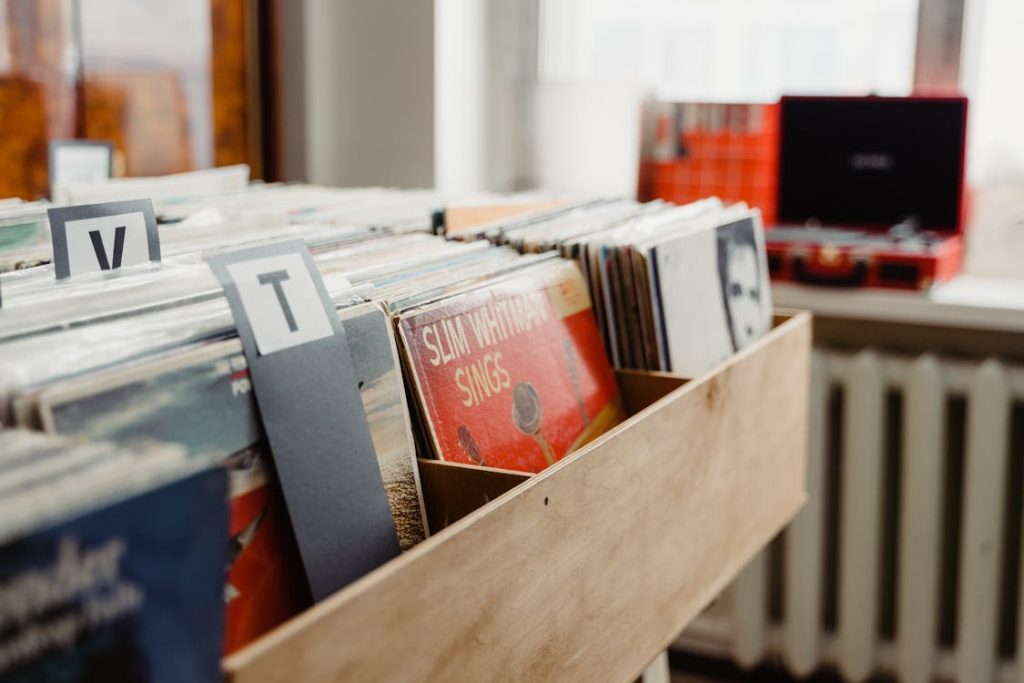
Every city has its record-hunting terrain, but Delhi’s is uniquely layered — stratified with the sediment of half a century of film culture, classical music patronage, and a middle class that once bought LPs the way it later bought cassette tapes: compulsively, abundantly, and then largely forgot about them.
That forgetting is your opportunity.
The Lay of the Land
Lajpat Rai Market in Chandni Chowk is the obvious starting point, and for good reason. The electronics wholesale district has, in its margins and side lanes, a handful of shops that have been dealing in second-hand audio equipment since before the cassette era. The vinyl here tends toward the practical — HMV pressings of Lata and Rafi, worn Decca jazz imports, the occasional treasure buried under a stack of 78s that were never properly sorted.
Come early. The good pieces surface before 10 a.m. and disappear into someone’s bag before noon. Bring cash in small denominations. Negotiation is expected, but walking in aggressive will cost you goodwill with dealers you will want to visit again.
The Sunday Circuit
The more productive hunting ground, for those willing to give up their Sunday mornings, is the informal market that spreads along the periphery of Janpath each weekend. Here, among brass figurines and old film magazines, you will find a dozen-odd sellers who have accumulated vinyl from house clearances, ancestral estates, and the remnants of closed clubs and hotel ballrooms.
The condition is wildly variable. You will flip through fifty sleeves to find three worth considering. But those three — a first-pressing RD Burman orchestration with its EMI insert intact, an imported jazz LP someone’s grandfather brought back from London in 1969, a sealed Zakir Hussain on the World Pacific label — are the reason people keep showing up at dawn.
Always check the groove before buying. Learn to read the surface: a shiny record with no deep circumferential scratches is almost always playable. A cloudy, hazy surface is not, regardless of what the sleeve looks like.

What to Look For
The most undervalued category in Delhi’s second-hand market is 1970s Hindi film music on the original HMV Odeon label. These records were pressed in enormous quantities, but many were played to death or stored badly. A clean, flat copy of a Pancham score — Hare Rama Hare Krishna, Amar Akbar Anthony, Sholay, Kati Patang — commands serious prices among collectors internationally, but still turns up at domestic flea-market rates if you know where to look and what to look for.
Equally overlooked is Indian classical on the old Columbia and Odeon labels from the 1960s. Pressing quality on these is exceptional — EMI India’s plants produced vinyl that rivals contemporary audiophile pressings in terms of dead-wax depth and channel separation. A clean Vilayat Khan sitar record on the red-label Columbia from this era is not just a collectible. It is one of the finest listening experiences available on vinyl, anywhere in the world.
The Real Reason You Go
Every serious crate digger will tell you that the find is only part of it. The real pull is the conversation — with the dealer who has been selling since the 1980s and remembers which film star used to stop by, with the other collector rifling through the same bin, comparing grading standards and swap lists.
Delhi’s vinyl underground is small enough that everyone eventually knows everyone, and generous enough that newcomers are welcomed rather than guarded against. Show up. Flip through the crates. Ask the dealer what came in last week.
That, more than any specific address or map pin, is where the hunt begins.
